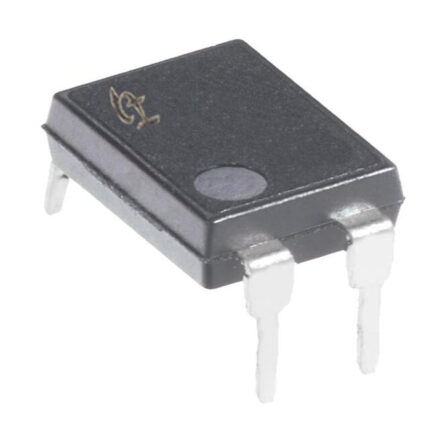
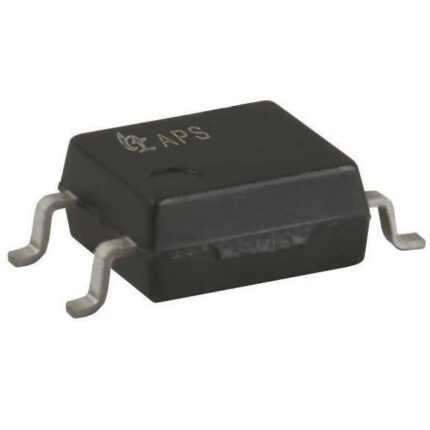
In the context of the rapid development of modern electronic engineering and information technology, system security and stability, as well as data transmission accuracy, have become core indicators for measuring equipment performance. Whether in the field of security monitoring, which safeguards social security, or in communication systems that build information bridges, complex electromagnetic environments, high-voltage surge impacts, and ground loop interference pose significant threats to sensitive microprocessors and core control units. The optoelectronic coupler, or optocoupler, as a key component that utilizes optical signals to achieve electrical isolation and signal transmission, plays an irreplaceable role in security and communication systems due to its excellent anti-interference capability, high insulation and voltage resistance characteristics, and unidirectional transmission mechanism. It has become the behind-the-scenes hero that ensures the efficient and stable operation of these two systems.
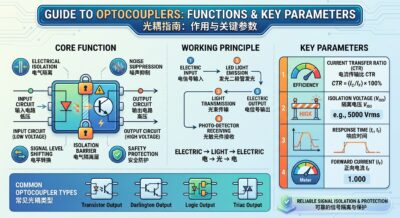
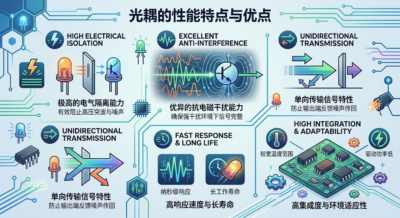
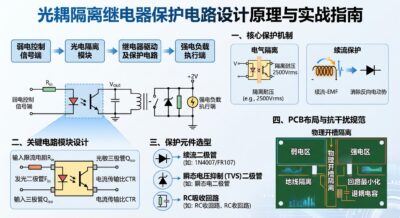
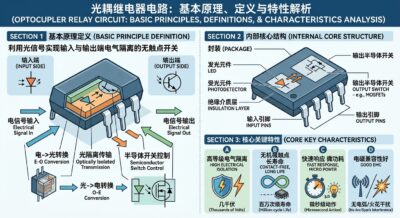
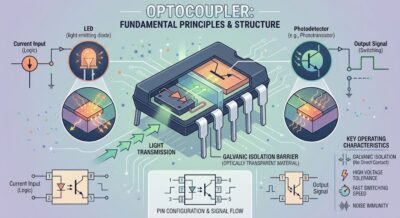
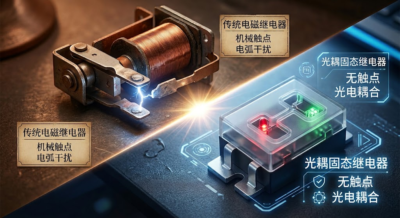
The core working mechanism of an optocoupler is based on the mutual conversion between electricity and light. It encapsulates a light-emitting diode (LED) and a photosensitive component, such as a phototransistor or a photosensitive integrated circuit, inside. When an electrical signal passes through the input terminal, the LED emits light of corresponding intensity, and the photosensitive component receives the optical signal and converts it back into an electrical signal for output. Since the input side and the output side are physically connected only through light as a medium, there is no direct electrical contact between the two ends, thus forming a very high level of electrical isolation. The insulation withstand voltage can usually reach thousands of volts, laying a solid foundation for outdoor high-voltage protection in security monitoring and long-distance data isolation in communication equipment.
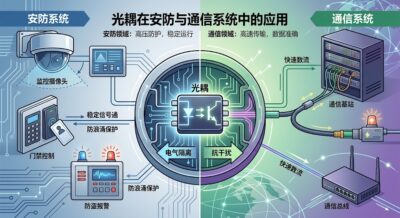
In the construction of a security system, security and continuity are of utmost importance. Security systems typically encompass multiple subsystems such as video surveillance, access control, burglar alarms, and fire linkage. The deployment environment for these devices is extremely complex, with a large number of cameras, sensors, and control terminals distributed outdoors or in industrial sites. Transmission lines laid over long distances outdoors are highly susceptible to lightning induction, electrostatic discharge, and interference from strong electromagnetic fields. If there is no effective isolation and protection between front-end devices and back-end video processing units or main control boards, high-voltage surges can flow back along the signal lines, instantly damaging expensive chips and motherboards, resulting in the entire security network being paralyzed.
In security surveillance systems, optocouplers are widely used in isolation circuits for video signal interface protection, pan-tilt control buses, and switch-level alarm inputs. For instance, in access control and burglar alarm systems, various front-end devices such as infrared detectors, door magnetic switches, and alarm buttons require their status signals to be aggregated in real-time to the central control panel. By incorporating optocouplers in the input channels, not only can high-voltage noise and ground pulses introduced from the front-end lines be completely cut off, but also ground loop currents caused by potential differences in different power supply areas can be effectively blocked, significantly reducing the false alarm rate. Additionally, the application of optocouplers in feedback regulation within switching power supplies can provide high-precision and stable voltage output for security equipment, ensuring round-the-clock uninterrupted operation of security surveillance.
Compared to the emphasis on high-voltage protection and anti-interference in security systems, communication systems place greater emphasis on high transmission rates, high linearity, and good common mode rejection capability in the application of optocouplers. In telecommunications base stations, fiber optic access networks, routers, program-controlled switches, and various industrial communication buses, optocouplers are core components for signal transmission across modulation zones, level conversion, and system lightning protection isolation.
With the evolution of communication technology, data transmission rates have doubled and redoubled. Traditional optocouplers struggle to meet the response speed requirements of high-speed digital communication. To this end, high-speed optocouplers have emerged. These optocouplers employ an integrated photodiode and high-speed amplifier circuit structure, capable of supporting high-speed data transmission at several megabits per second or even tens of megabits per second. In serial communication interfaces (such as commonly used industrial communication buses), due to long communication distances, there are often significant differences in ground potential between different nodes. If directly connected, ground currents can generate substantial common-mode noise on the data lines, leading to packet loss or even interface burnout. By incorporating a high-speed optocoupler between the transceiver and microcontroller of the communication bus, the ground loop can be perfectly blocked, ensuring the integrity and accuracy of high-speed data streams in strong interference environments.
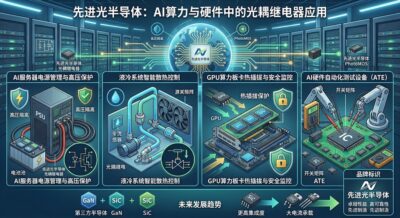
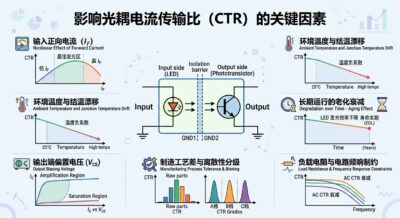
In addition, the power management module of the communication system is also a crucial stage for optical couplers to show their capabilities. Communication equipment typically requires a highly reliable switching power supply system to ensure pure DC power supply even during grid fluctuations. Linear optical couplers, due to their excellent linear relationship between input and output currents, are commonly used in power feedback loops to accurately and distortionlessly transmit voltage changes on the output side to the primary control chip. This not only achieves high-voltage isolation but also maintains high-precision regulated output of the power system.
In summary, optocouplers are not only miniature components that ingeniously convert “electricity to light,” but also serve as the cornerstone for building a robust barrier in modern security and communication systems. In the field of security, they prevent high-voltage surges, eliminate environmental interference, and safeguard the stability and security of security systems. In the field of communication, they cut off ground loop noise, enhance transmission rates, and ensure the efficient and precise flow of massive amounts of data. With the continuous evolution of high-density integration, low power consumption, and extremely high-speed optocoupler technology, optocouplers will inevitably play a more pivotal role in the intelligent upgrade of security systems and the construction of communication infrastructure, continuously providing protection for security and information connectivity in the digital society.
The above is the entire content of this article. If you find this article helpful, please continue to follow our website https://www.a-semi.com and the official account of “APSEMI”. We will bring you more news and information!
Copyright Notice: Some article information is sourced from the internet and user submissions. This website is solely responsible for organizing, formatting, and editing the articles. It aims to disseminate more information and does not necessarily endorse the views expressed or verify the authenticity of the content. If the articles or reprints on this site involve copyright issues, please contact us promptly, and we will address them as soon as possible.