In the fields of industrial automation, power control, medical equipment, and smart home, relays play an indispensable role as core components for circuit switching and isolation protection. For a long time, traditional electromagnetic relays, represented by electromagnet-driven mechanical contacts, have dominated the market. However, as electronic technology evolves towards high reliability, high frequency, and miniaturization, optocoupler solid-state relays are gradually replacing traditional relays in an increasing number of key application scenarios due to their unique advantages of contactless operation, long lifespan, and high-speed response.
This article will deeply analyze the key differences between optocoupler solid-state relays and traditional relays from multiple dimensions, including working principles, structural characteristics, performance indicators, and application scenarios, to assist engineers and technology selection personnel in making more reasonable decisions.
Fundamental differences in core working principles and structures
The fundamental difference between the two types of relays lies in their physical structures and energy conversion methods.
Traditional electromagnetic relay
Traditional relays operate based on the principle of electromagnetic induction. When the coil at the input terminal is energized, a magnetic field is generated to attract the armature, which, through a mechanical linkage mechanism, drives the contacts to close or open, thereby connecting or disconnecting the output terminal circuit. Essentially, it is a mechanical switch driven by an electromagnet.
Optocoupler solid-state relay
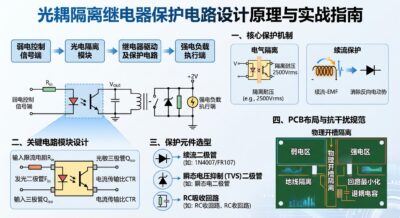
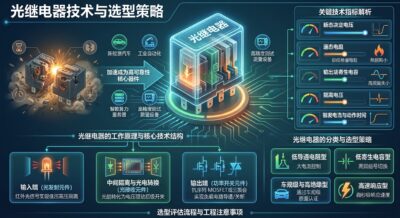
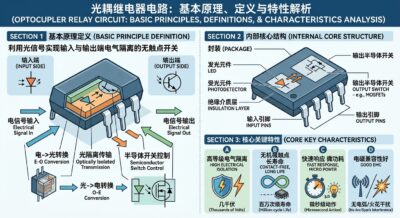
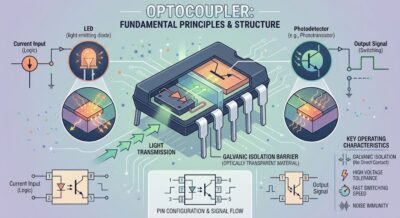
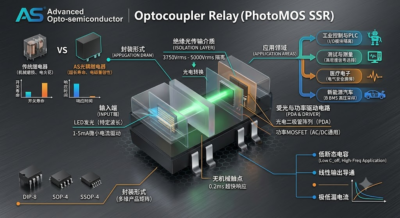
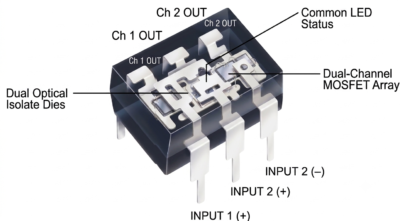
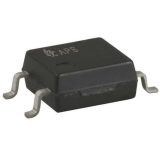
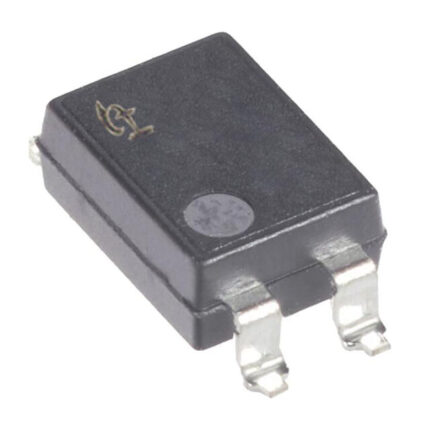
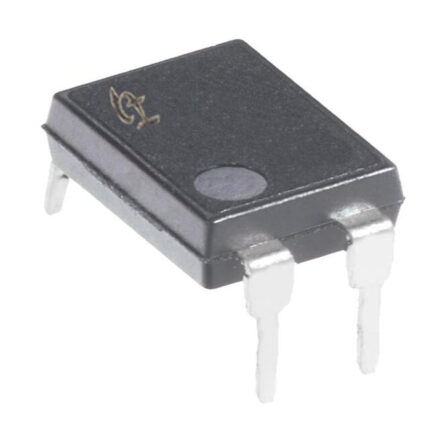
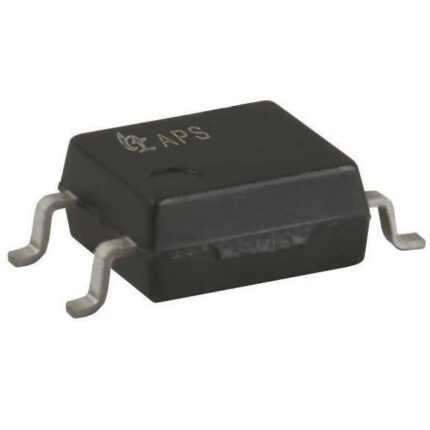
The optocoupler solid-state relay is a fully electronic, contactless switching device. It employs an optocoupler for isolation between its input and output terminals:
Input control: The low-voltage signal drives the light-emitting diode at the input terminal to emit light.
Photoelectric conversion: Light passes through the isolating medium and illuminates the receiving chip at the output end.
Output execution: The receiving chip converts the optical signal into an electrical signal, which in turn drives the power output stage to either turn on or turn off.
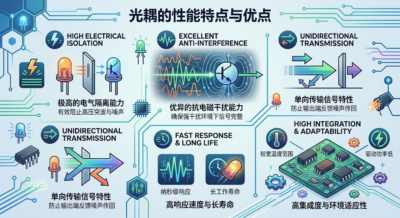
This design, utilizing light as a medium, enables the optocoupler solid-state relay to achieve electrical isolation while completely eliminating mechanical moving parts.
Comparative analysis of key performance and characteristics
Contact structure and service life
Traditional relays: They contain physical metal contacts. Each time they are closed and opened, physical wear occurs between the metal contacts. When controlling inductive loads (such as motors, solenoid valves), the generated arcs can lead to contact erosion, oxidation, and even adhesion, limiting their service life.
Optocoupler solid-state relay: It has no physical contacts. Due to the absence of mechanical wear and contact arcing, its lifespan mainly depends on the degradation of the semiconductor chip and light-emitting diode. Its theoretical lifespan is extremely long, and the number of switching cycles is almost unlimited, greatly reducing the cost of equipment maintenance in the later stages.
Response speed and switching frequency
Traditional relays: Limited by the time required for the coil to establish a magnetic field and the mechanical displacement of the armature, their response time is relatively slow, typically in the millisecond range, making them unsuitable for high-frequency switching scenarios.
Optocoupler solid-state relay: Leveraging the transmission of light and the rapid switching characteristics of semiconductors, its response time can be shortened to the microsecond level. This makes it easily capable of handling applications that require extremely high real-time performance, such as pulse width modulation regulation and high-frequency signal switching.
Environmental adaptability and explosion-proof performance
In environments containing flammable and explosive gases, high dust levels, strong vibrations, or requiring extreme silence:
The contact arcing of traditional relays poses safety hazards, and vibration may cause contact jitter, leading to false triggering and accompanied by significant mechanical switching noise.
The optocoupler solid-state relay adopts an all-solid-state packaging, with no internal gas gaps or mechanical structures. It is explosion-proof, shock-resistant, completely silent, and exhibits strong adaptability to harsh environments.
Conduction loss and leakage current
Although optocoupler solid-state relays excel in multiple indicators, traditional relays still retain their inherent physical advantages in terms of electrical performance:
Conduction state: The metal contacts of traditional relays have extremely low resistance, resulting in minimal heat generation when passing high currents. However, the power semiconductors of optocoupler solid-state relays exhibit a fixed voltage drop or conduction resistance when conducting, leading to significant heat generation under high currents, often necessitating the addition of an external heat sink.
Disconnected state: After the contacts of a traditional relay are opened, they are air-insulated, resulting in almost zero leakage current; whereas the semiconductor output stage of a solid-state relay still has a small leakage current in the off state.
Suggestions for selecting typical application scenarios
Based on the differences in technical characteristics mentioned above, the two have their respective focuses in practical engineering selection:
Scenarios where optocoupler solid-state relays are preferred:
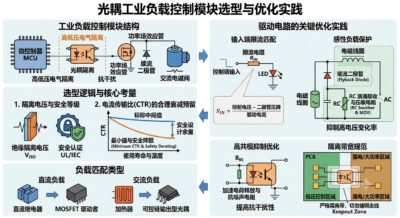
Industrial temperature control system: requires high-frequency switching of heating wires. Traditional relays are prone to wear and tear, making solid-state relays the absolute first choice.
Medical equipment and high-end instruments: They require absolute silence, high isolation, and low electromagnetic interference.
Automation control module: used for dense signal isolation output, requiring small size, fast response, and long lifespan.
In flammable and explosive chemical environments: explosion-proof and spark-free control nodes are required.
Scenarios where traditional electromagnetic relays are preferred:
High cost-effective household appliances: such as high-power power supply master switches on the mainboards of microwave ovens and rice cookers.
Strong isolation and safety isolation circuits: It is necessary to ensure complete physical disconnection to comply with specific safety standards.
In situations where high current is required and space is limited: where it is impossible to install large heat sinks but high current is necessary.
The relationship between optocoupler solid-state relays and traditional electromagnetic relays is not simply one of substitution and being substituted, but rather a complementary pattern formed based on different industrial and electronic needs.
Traditional electromagnetic relays have maintained a stable position in high-current control and cost-sensitive fields due to their ultra-low on-resistance, zero leakage current, high cost-effectiveness, and natural physical isolation. On the other hand, optocoupler solid-state relays are becoming the absolute mainstay in high-reliability, intelligent, and high-precision control circuits, thanks to their contactless design, zero noise, long lifespan, high-frequency response, and excellent anti-interference capability.
For electronic engineers, a deep understanding of the internal mechanisms and performance boundaries of both is essential. By weighing cost, lifespan, environmental factors, and electrical parameters in design, they can select the most stable and reliable switching solution for the system.
The above is the entire content of this article. If you find this article helpful, please continue to follow our website https://www.a-semi.com and the official account of “Advanced Semiconductor” on WeChat. We will bring you more news and information!
Copyright Notice: Some article information is sourced from the internet and submissions from netizens. This website is solely responsible for organizing, typesetting, and editing the articles. It aims to disseminate more information and does not imply endorsement of the views expressed or verification of the authenticity of the content. If the articles and reprints on this site involve copyright issues, please contact us promptly, and we will address them as soon as possible.