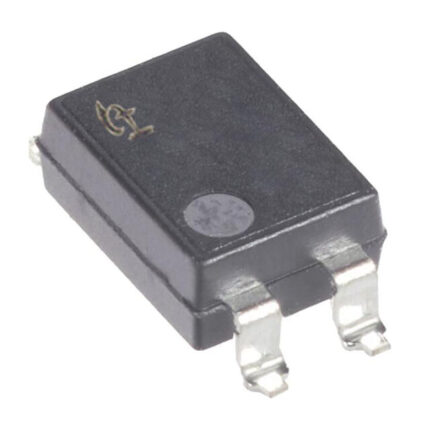
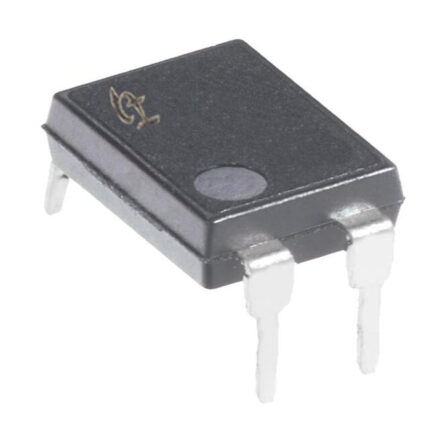
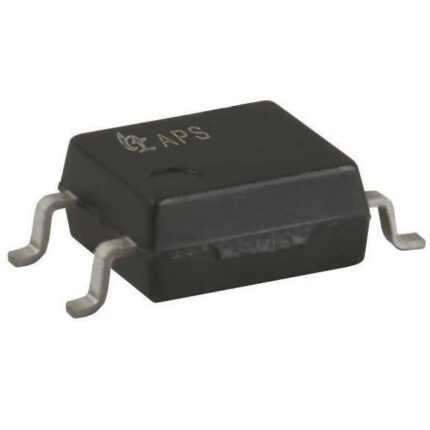
In the grand process of carbon neutrality and global energy transition, the rapid iteration of new energy technologies such as photovoltaics, wind power, and electrochemical energy storage is driving the evolution of power electronics architecture towards high voltage, high power density, and extremely high reliability. From distributed photovoltaic inverters to hundred megawatt level energy storage plants, the equipment often integrates high-voltage DC side and low-voltage microcontroller control side at the kilovolt level. In this context, optocouplers, as the core components of electrical isolation and signal transmission, are playing an irreplaceable role as “security guards” and “communication bridges”.
1、 The core mechanism of optocouplers is to use light as a medium to cut off high voltage risks
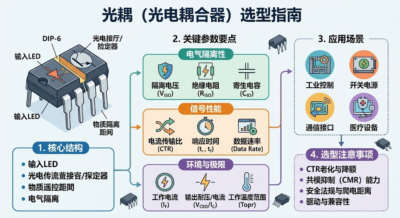
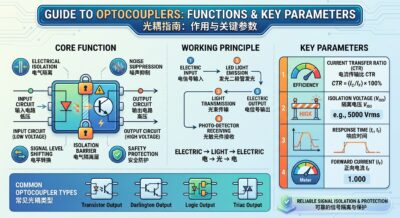
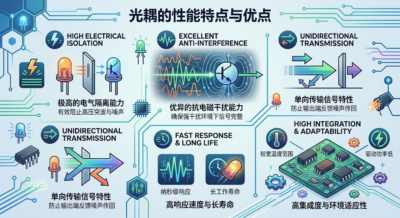
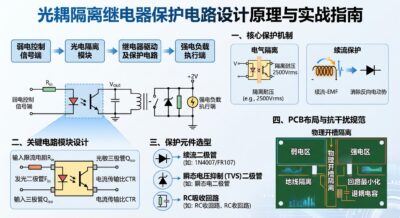
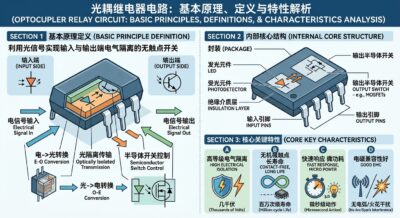
Optocouplers are electrical optical electrical conversion devices that use light as a medium to transmit electrical signals. It encapsulates light-emitting devices (such as infrared light-emitting diodes) and light receiving devices (such as photodiodes, phototransistors, or phototransistors) in the same sealed tube casing. When an electrical signal is applied to the input terminal, the emitter emits photons, and the receiver receives the photons to generate a photocurrent, thereby achieving unidirectional transmission of the signal.
In new energy and energy storage systems, the core value of optocouplers lies in electrical isolation and common mode rejection (CMR):
High voltage safety isolation: The voltage between energy storage battery arrays and photovoltaic busbars has generally entered the era of 1500 volts. Optocouplers use optical media to achieve physical isolation between input and output terminals, with isolation voltages typically ranging from 3750 volts to 5000 volts absolute effective value, effectively blocking electrical breakdown threats from the high-voltage side to low-voltage control chips (such as digital signal processors or microcontrollers), ensuring the safety of equipment and maintenance personnel.
Noise and interference suppression: The widespread application of third-generation semiconductor materials such as silicon carbide (SiC) and gallium nitride (GaN) in inverters has significantly increased the switching frequency, but also brought about extremely high voltage change rate (dV/dt) noise. Drive optocouplers and high-speed optocouplers with high common mode rejection capability can accurately filter out high-frequency electromagnetic interference, ensuring that control signals are not distorted in harsh electromagnetic environments.
2、 Four key application scenarios in new energy and energy storage systems
In a typical energy storage converter (PCS) or optical storage integrated machine, different types of optocouplers are distributed in various core modules, jointly building the safety protection network of the system:
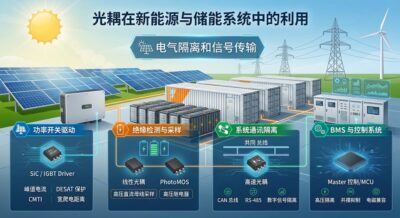
1. Gate Driver Optocouplers for Power Switching Devices
The core of energy storage inverters and photovoltaic inverters is the inverter bridge, which is composed of insulated gate bipolar transistors (IGBT) or silicon carbide MOSFETs. The driving optocoupler is directly connected to the controller and the pins of the power switch device, providing a peak driving current of several amperes to achieve rapid turn-on and turn off of the power device. In addition, the high-end driver optocoupler also integrates desaturation (DESAT) short circuit protection, undervoltage locking (UVLO), and fault status feedback functions. In the event of a short circuit fault in the power transistor, it can be urgently shut down in microseconds to avoid expensive power module burnout.
2. Insulation detection and status switching of battery management system (BMS)
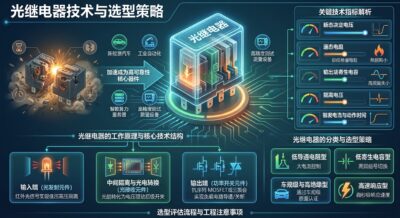
The Battery Management System (BMS) is the safety hub of the energy storage system. To monitor the insulation condition of the kilovolt battery array to the ground (GND) in real time, the system needs to regularly connect or disconnect the high-voltage sampling circuit. In this scenario, optoelectronic solid-state relays (PhotoMOS/optocoupler relays) are widely used. PhotoMOS adopts a photo driven MOSFET structure internally, which has the characteristics of no mechanical contacts, no arc, high withstand voltage (600V to 1500V) and extremely low leakage current, and can achieve millisecond level safe high-voltage switching and insulation resistance detection.
3. High precision sampling of bus voltage and current (LinearOptocouplers)
In order to achieve closed-loop control and overvoltage protection, the system needs to collect real-time DC bus voltage and phase current. Linear optocouplers utilize a dual light receiver structure to compensate for the nonlinear characteristics of light-emitting diodes, providing extremely high linearity and low temperature drift. They accurately replicate and transmit the analog sampling signal from the high-voltage side to the low-voltage control terminal, ensuring the precise operation of the system control algorithm.
4. System communication and bus isolation (High Speed Optocouplers)
The energy storage power station contains BMS, EMS (Energy Management System), PCS, and various sensors, and the modules exchange high-frequency data through CAN bus, RS-485, or Ethernet. A high-speed digital optocoupler with a transmission rate of 10 megabits per second or even higher can achieve real-time lossless data transmission while isolating ground loops and high-frequency interference, preventing system misoperation caused by packet loss.
3、 The Trend of Technological Evolution and the Wave of Domestic Substitution
With the evolution of new energy systems towards high voltage, high frequency, and high reliability, optocoupler technology has shown four significant trends:
Higher isolation level and creepage distance: Suitable for the needs of 1500 volt photovoltaic energy storage systems, the new optocouplers commonly use widened packaging (such as wide body SO8, DIP8), which increases the creepage distance to over eight millimeters and meets strict safety certification standards.
Higher common mode rejection capability (CMR): In response to the high dV/dt challenge brought by silicon carbide, the dynamic common mode rejection capability of the new drive optocoupler has exceeded 50 kV/microsecond and even 100 kV/microsecond, significantly improving the anti-interference ability of high-frequency inverters.
Higher integration and intelligence: Intelligent drive optocouplers that integrate drive, protection, fault diagnosis, and temperature monitoring have gradually become the preferred choice for high-power density inverters.
At the same time, in the context of the reshaping of the global supply chain, the domestic optocoupler industry has ushered in unprecedented development opportunities. From traditional general-purpose transistor optocouplers to high-end high-speed optocouplers, driver optocouplers, and PhotoMOS optical relays, domestic semiconductor companies are gradually breaking through material and packaging process barriers. With rapid localized technical service response, optimized cost structure, and gradually improved vehicle specifications and industrial quality system, domestic optocouplers are accelerating their transition from “replacement” to “mainstream”, providing solid guarantees for the supply chain security of the new energy and energy storage industries.
Conclusion
In the booming wave of new energy and energy storage technology, optocouplers, although basic components, bear the core responsibility of system safety isolation and efficient operation. From precise driving of high-voltage power devices, to insulation protection of battery arrays, and to data communication in complex electromagnetic environments, optocouplers, with their unique physical isolation characteristics, build a robust protective network between high-voltage power electronics and low-voltage digital control. Looking ahead to the future, with the continuous innovation of materials science and packaging technology, optocouplers will continue to move towards high frequency, high efficiency, high integration, and high reliability, injecting a continuous stream of micro power into the global energy green transformation.
The above is the entire content of this article. If you find it helpful, please continue to follow our website https://www.a-semi.com As well as “Advanced Optical Semiconductor” WeChat official account, we will bring you more news and knowledge!
Copyright Notice: Some article information is sourced from the internet and submissions from netizens. This website is only responsible for organizing, formatting, and editing the articles for the purpose of conveying more information, and does not imply endorsement of their views or confirmation of the authenticity of their content. If there are any copyright issues related to articles or submissions on this website, please contact us promptly and we will handle them as soon as possible.